Tuesday, August 4, 2020

The Day the Sky Fell

On the day the sky fell
And life turned to rubble
I looked around and cried.

My soul whimpered
"It hurts."

My heart whispered
"I know."

"What do I do?" my soul asked.
"Sit", said my heart.
"Sit, and I shall sit here with you."

"But it's broken," my brain wailed.
"We need to fix it."

"We will," assured my heart.

"When?" accused my brain.

"When we can see through the pain," my heart replied.

"We cannot fix what we do not understand.
So for today,
come.
Sit with us.
Feel.
The pain will help teach us what we need to know."

My brain sat.
And after a few moments,
whimpered
"It hurts."

Reaching out its hand,
my soul whispered back
"I know."

Holding them both, 
my heart pointed out
"It should."

On the day the sky fell
And life turned to rubble
I looked around and cried.

Friday, June 19, 2020

Juneteenth in the Land of Immigrants

I'd like to tell you a story about immigrants.

Once upon a time, some people fled the country of their origin in search of a better life. They were being poorly treated by their government and didn't have as much freedom or as many resources as other people they knew about. They wanted better for themselves and their children.

The journey was hard, and some of them died on the way. But some of them made it.

They brought much with them. Their hopes, their dreams, their ideas, their hard work.

They were met by people already living there with a combination of hospitality, hatred, excitement, and fear. Resources were shared and cultures exchanged. Some of the immigrants also committed crimes, and made communities less safe. But the immigrants were also creators. They used their determination for a better life to build buildings, and farm fields, and expand economies. They were brilliant.

Unfortunately, the government was not very good to them. Their legal status wasn't clear, their rights not assured. Their labor was undervalued. This golden land of opportunity they dreamed of was not everything they had hoped.

The above can be read as the story of the DACA policy, which provides some support for immigrants in America, and is currently under threat even though it was partially protected by the Supreme Court this week. But it also serves as prelude to another immigrant group's story. So I'll continue theirs.

Yearning for opportunity, these immigrants took action to get more. And sadly, they were willing to do so by violently harming and using others. Those who had travelled in search of a better life began to take it from others through force. Resource sharing became resource stealing. They shoved aside the local people and bargained with the country they had emigrated from to enslave other people to build their cities and work their farms. Their dream for opportunities became greed, selfishness, and assumed superiority - a willingness to become the very thing they had fled.

Decades passed. The immigrants became second, third, fourth generation. Yet their ancestors' initial reason for fleeing their home was not forgotten, and they still were not granted full political or economic rights. So they began to be violent not only toward the locals and the people they'd enslaved, but their government. They rioted. They threw things in rivers, and burned cities, and killed people. They overthrew their rulers and created a new system with claims to equality, life, and liberty.

Tragically, the children of those immigrants didn't really mean equality for all. They meant rights for themselves, seeing themselves as 'more' human while they continued to horrifically use and abuse others. They forcibly relocated nearly all of the original inhabitants of their new country, killing thousands. They continued brutal systems of slavery, classifying people as property. But over time, some of them woke up. And they realised this was horrific, and they were doing what they had fought against. They wanted to make it stop.

It wasn't easy. Some of the immigrants' descendants formed a new government to ensure slavery would continue. Those on the side of humanity-over-profit claimed freedom for the slaves held by secessionists and won the ensuing war.

But by this time, the descendants of those immigrants had journeyed deep into their new country. Some of the secessionists lived very far away indeed, and had with them the people they'd enslaved. There was little enough government presence that they were able to continue practicing slavery.

That is the story of Juneteenth. On 19 June 1865, two and a half years after the Emancipation Proclamation, an army general finally announced federal orders ending slavery in Texas. Slavery continued to be legally practiced in the Union border states until the Thirteenth Amendment passed another six months later - and even that did not universally abolish slavery, allowing for its use as legal punishment.

America is the land of immigrants, created by Britons who left an oppressive country seeking freedom only to become far more horrifically oppressive themselves.

America is the land of immigrants, but forcibly 'immigrated' 600,000 African slaves to that land. Half of that number were transported and kept in chains before 1776 and the country's founding. Slavery in America began four centuries ago, lasting from 1619 to 1865. Though most slavery was outlawed with the Thirteenth Amendment, but segregation was legally mandated shortly after the Civil War with horrific dehumanizing impacts and severe restrictions on the educational, economic, social, and political opportunities of anyone deemed as not "white". After two and a half centuries of zero rights, the Jim Crow era involved a century of minimal rights. And while the Civil Rights Movement accomplished much, Black people in the United States continue to be disadvantaged from centuries of their ancestors' oppression as well as continuing racial discrimination. America is not even sixty years into the right to vote - and just like slavery didn't end with the Emancipation Proclamation, Black voter suppression did not end with the Voting Rights Act, but continues to be practiced through a variety of intentional intimidation, logistical, and bureaucratic tactics.

America is the land of immigrants, but violently relocated indigenous communities, effectively making them 'immigrate' to designated zones so white colonizers could claim their land. The United States has and continues to treat Native American communities horribly - stripping them of life, home, culture, and history.

America is the land of immigrants, but met Irish, Eastern European, Asian, Latinx, and Arab newcomers - and continues to meet their descendants and so many others - with exclusion, disdain, and violence.

Today on Juneteenth, we celebrate the end of Black slavery in Texas and the progress we have made. But on this and every day, we must also recognise just how far we still have to go, and hold ourselves accountable. White America's racism means that Black, Indigenous, and People of Color are disproportionately convicted of crimes - and thus are legally still subject to and experiencing forms of slavery and involuntary servitude today, in addition to the everyday microaggressions and systemic barriers faced through economic, social, and political disenfranchisement.

America, the land of immigrants, proclaims to the world "Give me your tired, your poor, your huddled masses yearning to breathe free."

But for so many Americans, the reality is #ICantBreathe.

America. We yearn to breathe free. Lift your lamp.

Friday, April 10, 2020

Reflecting on a Broken, Wonderful World

It's a strange season.

This Passover, Jews around the world are sheltering in their homes as children ask "Why is this night different from all other nights?", even though every night now feels the same.

This Holy Week, Christians across the globe are wondering how to celebrate a resurrection while so many are dying.

This year, millions all over the planet are suffering from the same hunger, illness, exploitation, and insecurity as they did long before - and will long after - COVID-19 gave pause to those of us with privilege.

I rewrote the lyrics to Thiele and Weiss' "What a Wonderful World" to capture my mixed feelings of despair and hope at the moment. Thanks, always, to the brilliant Mr Louis Armstrong, who lived his life in a world that denied him rights and yet still saw great beauty. We owe him and so many others so much more. May we use these days to give it to them.

And please - add a verse! What's giving you hope these days? Share a few lines in the comments. ☺


I see war and greed
Famine and flu
All of our hate
Will kill me and you
And I think to myself
What a hurt, broken world

I hear thousands cry
Trauma and woe
We've caused more harm
Than we even know
Yet I hope to myself
We might heal this hurt world

The colors of the rainbow
So pretty in the skies
Are also on the masks worn
By nurses saving lives
I see strangers cross streets
Waving "How do you do?"
Keeping their distance
To save you

I see love so deep
And smiles so bright
Kids calling grandma
To FaceTime good night
And I think to myself
There is hope for this world

I see milk dropped off
For Old John next door
Hands lending aid
Without keeping score
And I know in my heart
We could heal this hurt world

Yes, I ask you today
Help me heal this hurt world

Sunday, November 11, 2018

Remembering to Change

One hundred years ago today, a war ended. And a handful of diplomats began working to create a world in which such violence would no longer exist.

They failed.

And yet...

Today, we remember.

We remember the children, women, and men who died for no reason other than being in the wrong place at the wrong time.

We remember the soldiers who fought and killed, trying to live their values.

We remember the individuals who decided that their values required working toward an end to the violence more than the vanquishing of another worldview.

We remember the lessons learned.

We remember that those lessons have been forgotten, and relearned, and forgotten again in other wars.

We remember that, while they are not named “World Wars”, other incarnations of political violence and structural injustice continue to kill and harm by the thousands.

We remember the soldiers neglected by a system that doesn’t care well for its veterans.

We remember the fathers sorrowed by empty arms that will never again hold a daughter who didn’t come home from the front.

We remember the children gunned down in our streets by the same hatred that makes killing on such a large scale possible.

We remember our complicity in creating and reproducing systems that make war an everyday reality, rather than a “never again” memory.

We remember our guilt.

And yet...

We also remember our hope. We remember the inspiration of Malala, Ruby, and Emma - children who worked to show us that they believe in something better.

We also remember our strength. We remember the change created by Mahatma, Wangari, and Martin - leaders who marched to demonstrate that we too hold power.

We also remember our compassion. We remember the difference made by Harriet, Oskar, and Teresa - caregivers who laboured to alleviate suffering.

And maybe, just maybe, if we remember enough, we’ll learn this time. And more of us will be Malalas and Wangaris and Harriets, and fewer of us will be soldiers and victims and mourners.

Remember.

Remember.

Remember.

Then change.

Tuesday, August 28, 2018

Sustainability Signature Seminar

Phew.

Here I am.

(In London.)

I've been a lot of places in the past ten days.

Oh, the fun I get to have every August and January with my new job at Syracuse, leading a travelling seminar on sustainability and environmental justice for 18 undergraduates.

From our course overview:


In the wake of the Cold War, environmental concerns took a new place on the global stage. The end of the 20th century saw the birth of formal international conservation and climate efforts, which most scholars trace to The Brundtland Commission’s Our Common Future report, released in 1987. Led by a former Norwegian Prime Minister, this body warned that humanity is pushing the finite carrying capacity of the planet to saturation. While such claims were not new, they were framed as increasingly urgent - and the international community began to respond. That report led the way to the Rio Declaration, the United Nations Framework Convention on Climate Change, and other major global mechanisms for emissions reduction and ecological conservation.

While shared environmental concern has led to unprecedented international cooperation around certain issues, much of the action seems to be ‘too little too late’. Climate change scientists are alerting us to the hottest temperatures on record, and we are losing vital ecosystems like the Arctic ice sheet at previously unanticipated rates.  Urban infrastructure, rural livelihoods, endangered species, habitats, and island nations are regularly devastated by extreme weather events, which are occurring with increasing frequency. And the effects of these droughts and disasters are far from equally felt. Those who contribute most to global warming through energy and other resource use feel its negative consequences the least. This reality raises serious questions about justice, equality, and power in climate change and human-environment systems.

This course is designed as a prequel that frames a semester abroad in the global city of London. Before starting a term of more traditional coursework at Faraday House, participants on the Signature Seminar will visit several Nordic countries, where the negative impacts of global environmental crises are felt most acutely in Europe. But it’s not all bad: This region is also home to some of the world’s greatest progress toward a form of sustainable development that “meets the needs of current generations without compromising the ability of future generations to meet their own needs” (The Bruntland Commission). This course examines the concepts of sustainability and environmental justice, using ethnographic practices of critical geography to explore how European countries are innovating and experimenting with alternative approaches to life, business, and society. These investigations aim to shift how we think about ourselves as humans, as animals, and as beings of Nature - independently and in relationship.

Students are guided through the established discourses and critiques of sustainability as an academic field. Three pillars, identified by Elkington (1994) and furthered in business and city planning as well as philosophy and environmental studies, will be used as core considerations: people, planet, and profit. This and other traditional conceptions of sustainability will be examined through the lens of various critical scholars and on-the-ground case studies. The course will recognise the progress that has been made and the political difficulties of additional action, even as it argues that the mostly negative (responsive, focusing on preventing, avoiding or solving human problems) efforts of these ‘exemplar’ countries fall short of what positive (proactive, working for the continued flourishing of all life on Earth) sustainability could and should be.

These challenges to and criticisms of sustainability as it is frequently understood (and, perhaps, given lip service and regarded as a buzzword more than anything else) will be complemented by an examination of environmental justice. Working from Schlosberg’s 2004 framework, students will explore the distribution of environmental benefits and costs, participation in decision-making around systems and policies, and the recognition of varied beliefs, values, and actors. Class discussions will question how these three dimensions are considered and addressed or ignored by the various initiatives visited in the field. Observing direct inequalities in access to air, land, food, water, oil and gas, and trees and forests will enable students to consider how environmental injustice has already led to the emergence and growth of protest movements and might inspire new responses. After exploring urbanscapes in several eco cities, the seminar’s final stop takes students to the Sápmi region, recognised as one of the area’s last wilderness spaces, for a chance to discover how climate change disproportionately affects the indigenous Sámi people.

Throughout the Signature Seminar, students will encounter multiple, sometimes contradictory, meanings of and approaches to sustainability and environmental justice - allowing them to consider whether these concepts have been reconstructed so often by different people and for various purposes that they no longer retain their original intentions. Viewing these ideas as essentially contested concepts - with meanings that can neither be discovered nor fixed - is useful in theory and practice, enabling an awareness of different stakeholders' priorities and assumptions. Ultimately, the Seminar aims to equip students in becoming positive agents, working as makers rather than victims of global change while supporting others to be the same. Doing so involves shifting priorities: moving from an anthropocentric (human-centred) value system toward an ecocentric (environment-centred) understanding of the world and an appreciation of the interconnectedness of life on Earth. This launches students’ development as global citizens at Syracuse London, where co-curricular programming will emphasise the responsibility we have as members of the world community to care for both people and planet.

***

The photos of me are minimal, as I was focused on teaching and taking shots of the students - and I can't post pictures of my students on my personal blog. But, here is a reindeer who apparently got into the hard hay or something (seriously, what a facial expression), as well as a super cute little one. And then, me loving on one of the huskies we took foraging for berries and mushrooms in the forested wilderness. Happy, happy Becca. 


Tuesday, July 17, 2018

The Burn

Every year, the Marshall Scholars take a weekend retreat in the low Scottish Highlands. After a truly gorgeous 6.5-hour-train ride through northern England, Edinburgh, and the Forth of Fife (including views of the world's best bridge), we end up at this beautiful country estate, where we proceed to enjoy ourselves pretending to be the British aristocracy at a house party for several days.

This year's delights included swimming in the North Sea (the weather was warm enough that I wasn't the only one to go in!), hiking the cliffs between a fishing village and Dunnotar Castle, and a staged murder mystery roleplay. (I am happy to report that I was neither murderer nor murderee.)

This year was especially fun since Hamza, my best friend from Jordan, was still in the country after the AMENDS Conference - as was his mother, since he's just had his graduation ceremony from the University of Manchester. So we brought along Jordanian mama, the educational entrepreneur, and a handful of miscellaneous international mates to join the American postgraduates in Scotland. It was quite the intercultural hoot, to say the least.

Hilariously, the blond boy pictured below in the University of Manchester t-shirt is not the Jordanian who graduated from the University of Manchester last week. We're just a very mobile bunch.


A grand time was had by all. And now...back to real life.

Tuesday, July 10, 2018

The growth of AMENDS

Many of you have heard me talk about AMENDS, the American Middle Eastern Network for Dialogue at Stanford. Being selected as a delegate for the 2013 AMENDS Summit was the proper launch of my PhD, as the people I've met through this network are directly responsible for all three of the organisations I partnered with to build knowledge around environmental peacebuilding.

I've just gotten back to London from an amazing several days in Oxford with a reunion conference for AMENDS Fellows - alumni of the Launch Summits the Stanford team host every year with new delegates. I'm very, very happy to announce some big news for the AMENDS Global Fellows:
  1. We are now a registered 501c3 non-profit in the US, giving us legal status independent of Stanford University, and the ability to receive tax-deductible donations (as well as applying for a multitude of grants)
  2. We have a brand new flashy website! Check out more at amendsfellows.org.


More about AMENDS:

The AMENDS Global Fellows are a network of young leaders from the Middle East, North Africa, and the United States who are working to build a more equal, sustainable, and prosperous world.
AMENDS began in 2011, when Arab youth led a wave of popular protests across the MENA region. Two Stanford University students, Khalid Shawi from Bahrain and Elliot Stoller from Chicago, imagined a platform and space for MENA and US youth to gather, collaborate, and share their stories of working for change. AMENDS welcomed its first class of 36 delegates to Stanford in 2012 for a week-long Summit.
Since then, AMENDS has welcomed 177 fellows from 26 countries to annual gatherings at Stanford University, Koç University, and the University of Oxford. These alumni form an active network committed to transformative work in the areas of arts and culture, business and technology, education and empowerment, health and environment, and human rights and political activism.
To better serve this growing network, AMENDS Global Fellows became an independent non-profit organization in 2017. We aim to support our fellows by:
  • providing a platform for fellows’ ideas and initiatives;
  • facilitating active engagement and communication among fellows and with the public;
  • providing resources and opportunities for capacity building, mentorship, networking, and project implementation.
The AMENDS student team at Stanford continues to lead a core part of our programming, selecting new delegates annually to participate in a launch summit and join the AMENDS Global Fellows network.
 

Wednesday, July 4, 2018

Family in London!

Thanks to the process of applying for a long-term work visa in the UK, I wasn't able to travel to the US and Canada at the end of June as originally planned to attend a conference and be present for my niece's graduation from high school.

But fear not! I somehow suckered my sister and brother-in-law into bringing everyone to visit me here instead. Mwahaha.


So there I was for my birthday yesterday, with my brother, sister and brother-in-law, and three adorable youngsters. Utterly miserable, of course, especially as we went to the Harry Potter Studios Tour in the evening. And since it was my birthday, Izzy and I got to open the doors into the Great Hall!


Their visit came immediately upon the heels of the Ellis Clan - my parents' best friends and the woman I was named after, plus various of their family members I grew up with. We frolicked about Greenwich, the London Zoo, and boat tours to the great enjoyment of all and sundry.

This is all to say: I have been rather spoiled by visitors of late. Are you going to be the next one?? :)

Wednesday, June 13, 2018

First Aid Training

On 1 August, I'll begin a full-time position at Syracuse University London as their Community Relations Manager, which includes running their internship program, creating volunteering opportunities for students abroad, and mentoring undergraduates' professional development. I will also be teaching three classes a semester, on themes of environmental justice and global citizenship.

One of the reasons I was so happy to say 'yes' to this job offer was the emphasis Syracuse London places on their staff's personal development. I've been working part-time with them for almost a year, and have had a lot of opportunities already - and seen others for my colleagues.

This week's 'fun' was a three-day intensive first aid training, including emergency action in the case of cardiac arrest, gunshots, roadside collisions, and the like. I've had a fair bit of training in the US through Girl Scouts, church, etc., but it was nice to add a formal UK qualification, and get a concentrated brush-up of the various bits and pieces I've picked up over the years!

Our full reception team, the facilities staff, and another professor we're trying to launch a second travelling seminar with also attended - so it ended up being quite a fun team bonding exercise as well, especially when we had our scenario and exam roleplaying sessions. You never quite know who you're working with till you see just how well they can fake a faint. ;)

Anyway, now I get to carry an official card and everything!


I'm not saying you should get into a life-threatening emergency just because I'm around. But if you do, mayhap I'll be of some use?!

Thursday, June 7, 2018

Thoughts on Volunteer Tourism

A professor from Michigan State poked me on Facebook, asking for comments on the following video about some of the problems with volunteer tourism (or 'voluntourism'):


So for this week's random post, my response: 

Travelling to places and performing 'service' can be and is often valuable - so long as you recognise and make explicit that it is service learning. The trip should be understood by all parties as an investment in the professional and personal development and worldivew of the traveller, at least as much as (and generally more so) a concrete form of support for a host community.

The inherent inequalities in the relationship also need to be addressed: Oftentimes, volunteer tourism involves a privileged person going to an underprivileged place and interacting with individuals whose level and types of privilege will not allow them to travel in the other direction. Tourists, hosts, and programs should consider how they want to tackle this issue - both within the trip and more systematically.

For my PhD, I spent time with three local organisations as 'free' staff while conducting fieldwork - but I wasn't really free labour; I interrupted work patterns and required plenty of attention and care. And I will always worry that I got more out of it than they did.

One concrete action I took in response to this concern: After my fieldwork, I used some of my research funds and applied for an additional grant to bring youth representatives from the organisations that had hosted me to a conference in the UK. Two of the students had never been on a plane or been able to leave their home country before. It was an absolute joy to be with them as they experienced a new place, and actively challenge the dominant flow of humans, expertise, and cultural exchange in the world.

Travel has massive impacts on people. It's up to us to make those impacts as positive as possible, and as equitable as possible. That means questioning when and where we and others can and can't go and why - and once we know some of those answers, to try and change them.

Friday, May 25, 2018

"Drops of Diplomacy"

For those of you interested in (1) what I was exploring with my PhD, (2) water, (3) politics, (4) the Middle East, (5) study abroad, (6) climate change, or (7) some random combination of the above: Feel free to check out a piece just published in The Journal of Hydrology. We've a window (till mid-July) during which you can read the article free online via https://www.sciencedirect.com/science/article/pii/S0022169418303378. After that, unfortunately it shifts to paid access through a corporate journal - though this means I will finally get a 'pretty' version of the PDF all formatted! If you'd like, do get in touch and I'm happy to send a copy of my accepted manuscript version as well.

The paper is a case study of one of my doctoral research partners. It argues that, by intentionally using fog to facilitate collaborative exchange, Dar Si Hmad is engaging in a form of hydro-diplomacy. Drawing from ethnographic data and building on international relations theories of Track Diplomacy, the paper demonstrates how fog water is being used to lay the groundwork for durable peace, intercultural understanding, and symbiotic growth. Such local iterations of hydro-diplomacy should be better understood and integrated with the emerging literature on state-to-state water cooperation in order to develop holistic expertise, share best practices, and promote positive policy interventions.

Enjoy! (Or don't. It's definitely the nerdy version of what I'm doing. You can always skim Dar Si Hmad's blog for the more-action, less-theory version of the story: http://www.darsihmadorg.blogspot.com/).

Thursday, May 24, 2018

Oops...it's been a while

Hello, all...and apologies! It's been far longer than I meant it to be.

Last I posted, I had submitted my initial thesis to King's College London. Since then, I:
  • Went to Israel for a friend's wedding and hosted my brother in London for Christmas;
  • Served as the geography professor for 17 students, leading them around Scandinavia and the Nordic region on a twelve-day field studies course on sustainability and environmental justice;
  • Took on a six-month contract covering some staff leave at Syracuse London, focusing on internships and communications;
  • Had my PhD viva, which was a very vibrant and fulfilling conversation that resulted in some really exciting revisions to the thesis;
  • Traveled to San Diego for a conference on preventing ocean plastics and other marine debris alongside partners from the Kuwait Dive Team;
  • Introduced my Moroccan fog-harvesting partner Dar Si Hmad to a handful of undergraduate and postgraduate students during a field school visit to Agadir;
  • Spoke at a conference in Lund, Sweden, on the 'Nature of Peace'; and
  • Played with lots of fabulous kids around London - most notably, hosting a sleepover for four young ones all at once one weekend.
It's been a very joy-filled and busy several months!

And, the big news:

Following the fun I've had with Syracuse London in a variety of roles, I am happy to announce that today I signed a contract with them for a full-time role. They are sponsoring me for a visa to remain in the UK, which has been a long journey and I'm very honoured that they have taken the trouble. I'll be their Community Relations Manager as well as an Adjunct Professor. In addition to teaching classes on sustainability, global citizenship, and professional development, I will be running programming on volunteering, internships, and community engagement. This means I get to do a loaded combination of teaching, event management, individual and group mentorship, and research impact activities. It's quite a perfect role for me, with my hands in lots of pies and my days never the same.

I imagine I will be blogging less frequently, as it won't be appropriate for me to share daily stories about my students here, and that will be the bulk of my time! But I will endeavour to send updates more than every five months, for goodness' sake. You can also check out the Syracuse London to get an idea of what I'm up to - for example, check out this blog written by one of my students describing our environmental journey up north: http://sulondon-blog.syr.edu/sustainable-europe-signature-seminar/.

All in all, life is grand and happy here in Londontown...especially as spring/summer is finally coming to the British Isles, and blue skies and green leaves are giving everything a glorious glow! All the best to everyone. :)

Monday, December 18, 2017

C'est fini!

I've been radio silent for a while...apologies. I had this idea that maybe I should actually work a bit.

Turns out, that wasn't a horrible idea! 96669 words later, I have a doctoral thesis submitted to the Examinations Office and a viva this winter. :)


Rather than reading my thesis, I suggest everyone stick to the acknowledgements. They say pretty much everything the academic nonsense actually means:


I am and always will be
the optimist
the hoper of far-flung hopes
the dreamer of improbable dreams.                          -The Eleventh Doctor
This project is dedicated to all those who and all that which
draws hope close and makes dreams real.
To Elliot Stoller and Khaled Alshawi, who acted on an idea to bring change-makers together; Dari AlHuwail, who asked if I would come write about divers in Kuwait; Abdelkrim Boublouh, who told me I should check out a little Moroccan NGO; Yasmeen Makarem, who connected me with a woman named Vanessa; and the many amazing AMENDS Fellows, who unapologetically rock the boat:
May you keep healing our world.
To Matt Zierler, who pointed out that I was allowed to blend my environmental and Middle Eastern obsessions; Mark Axelrod, who skilfully guided that blending; Mark Zeitoun, who asked if I might volunteer at a conference; Alex Loftus, who lured me to King’s with Marxist water theory; and Naho Mirumachi, who encouraged as well as she critiqued and let go as often as she redirected:
May you never forget that what you do changes lives.
To the Marshall Aid Commemoration Commission, the US Environmental Protection Agency, and the King’s College London Graduate School, School of Social Sciences and Public Policy Postgraduate Research Fund, Theme 13 Grant Scheme, and Department of Geography Small Grants Fund, which financed portions of this work and its dissemination:
May you continue to support communities as they explore.
To the indigenous women and foreign visitors of Dar Si Hmad, who share together in true collaboration; the Kuwaiti schoolchildren and international divers of the Environmental Voluntary Foundation, who clean beaches they did not make dirty: and the Lebanese journalists and Syrian refugees of the Media Association for Peace, who see creative solutions even in the dark:
May you always see I in Thou and Thou in I.
To Iorwerth and Rafael, who delighted more than they distracted and taught more with their laughter and tears than any book ever will:
May the Earth be good to you, and you to it.
And most especially, to the fog droplets in the Anti-Atlas that mystify; the cedar trees in the Chouf that inspire; and the sea turtles in the Gulf that entrance:
May this do some justice to your voices.


Wednesday, November 15, 2017

ClimateKeys at Syracuse London

A huge thanks to Syracuse student Caroline Colvin for capturing what I was up to last night so well! Check out the original post and her other great reflections on studying abroad in London: https://petitangebrun.wordpress.com/2017/11/14/getting-lyrical-with-climatekeys/


By the time 5:30pm rolled around Tuesday night, the 40 people chatting in Syracuse University London’s auditorium were doing so comfortably. Thanks to Cashew Catering, they were getting cosy with lentil chilli, slicking hummus and tapenade and yoghurt on artisan bread, savouring slow-roasted veggie salad and gently devouring every delectable, chewy brownie in sight.


These SU London students, faculty, staff and friends were gathered for ClimateKeys: A Musical Conversation about Environmental Justice. Similar to SU London’s free speech symposium, the evening was filled with discussion. But as the name would suggest, the event was dissimilar in that art reigned supreme as our medium of expression.

The night was kicked off by Jason, who introduced us to ClimateKeys and performed a piece about the power of music.


Next, we heard from Lola Perrin, who is also the founder of ClimateKeys. As a pianist and environmental advocate, Perrin is working at the intersection of creative expression and activism.


Shows in the 2017 ClimateKeys concert series have taken place elsewhere in the U.K., as well as in Canada, the U.S., Germany, Serbia, France, New Zealand, Turkey, Wales, Bosnia + Herzegovina, and Wales.

We then heard from concert guitarist Michael Poll and Rebecca Farnum, who is an expert in environmental and social justice as well as the Middle East.


We then were given binders to help lead our discussion. The couches we were sitting on were clustered by subject. The topics were war and conflict, technology and ethics, conservative voices (as in political diversity, not conservation), the media, non-human animals, food and agricultural systems, race and space, and global citizenship.

Inside each binder was a big question in our field of study that would get our wheels turning. There was also a sheet asking us to use David Schlosberg’s “three dimensions” from which we can analyze environmental justice issues. The questions we should ask are:

  • those of distribution, as in “Who gets what?”
  • those of participation, as in “Who makes decisions?”
  • and those of recognition, as in “Who counts?”


There were also relevant news stories in each binder that highlighted the timeliness of each topic.


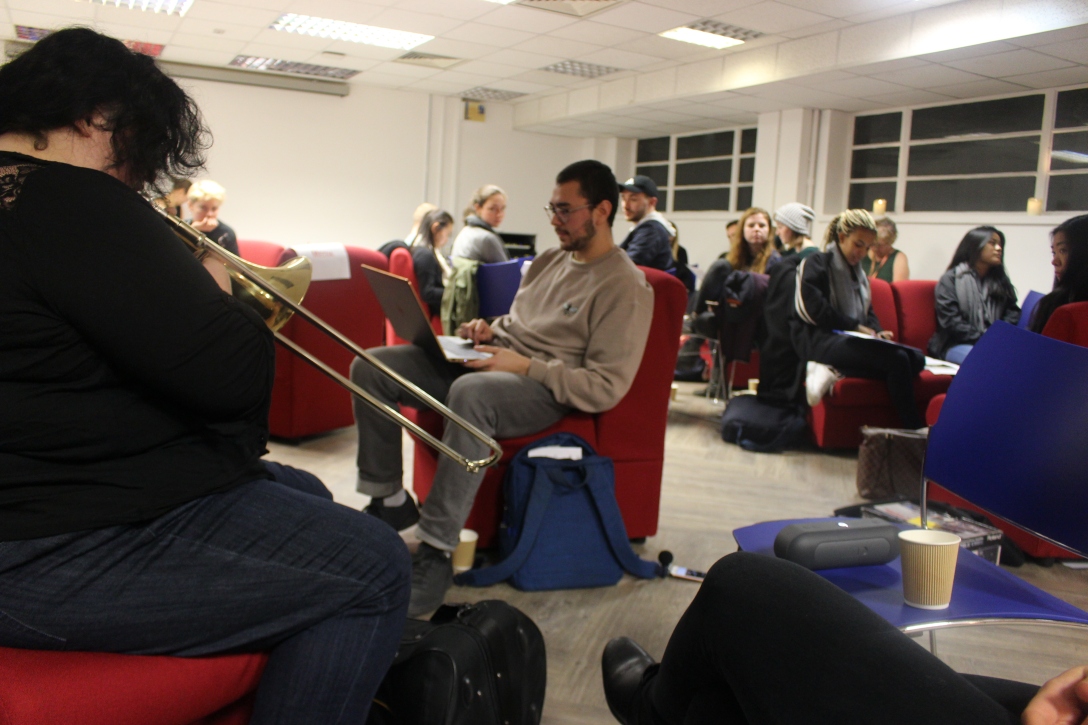
After our discussion as groups, Terrin, Rebecca, Maggie, Iain and Francesco performed an experimental piece about the death of coral reefs. The experience was achieved through a trombone, a trumpet, a bass guitar, a violin and ocean sounds.


Afterward, each group got to speak their piece and answer their question. It was refreshing and yet, unsurprising, how passionate and well-informed my peers are when it comes to climate change issues. Being a social justice-inclined bunch as it is, I shouldn’t expect anything less.

When it came time for the media group to speak, Andre performed a piece about the malleability of the “truth” when it comes to climate change. Likewise, when we arrived at the global citizenship group, I got to perform my own piece. It is about navigating life as a consumer in a developed, “first world” nation with enough money to have a disposable income, but not enough to afford ethically made clothes.

As someone who loves fashion, only has so much money at this time and wants to ensure that marginalized peoples aren’t further marginalized, I have a lot of guilt about my shopping habits. Next to being elated to have an outlet where I could express this sentiment, I was so grateful I got invited to perform tonight.

As a whole, I am glad events like those apart of Perrin’s ClimateKeys exists. Words are great, obviously, but there is something so magical about music and words repurposed into lyrics (as spoken word is more akin to).

On a personal note, it’s been a minute since I wrote poetry. Rediscovering that side of myself lately was nice.

It was also my first time performing original work in front of an audience. It felt so good to share, which is strange. After suffering from intense anxiety for most of my life, the thing I was most afraid of now feels good.

Helping spark discussion and lay the foundation for civic engagement among my peers tonight made me feel like I was making a tangible difference in the world. Know that if ever there arises another opportunity for me to give back and provoke people intellectually like ClimateKeys provided, best believe I’ll sign up.

Thursday, November 9, 2017

Fog Visit

Radio silence = Becca's been abroad!

I headed to Morocco yet again to visit research partner Dar Si Hmad. While I've seen most of the team, this has actually been on US and UK soil...I've hosted various staff members and volunteers for conferences and research projects abroad, but I hadn't actually been in Morocco myself in a year.

It was my first visit since the new form of fog nets were installed in the mountains. They are oddly beautiful, given that they're hunks of metal and mesh. I got rather excited about them, it must be admitted, and there are the visuals to prove it:


I took one of last year's UEA water security students, a Fulbright Scholar who had heard one of Dar Si Hmad's Environmental Youth Ambassadors speak about the fog project during a seminar in April. It was very cool to be able to make that exchange two-way and show Matt the project after so many months of talking about it. Of course the team welcomed us very warmly...with cous cous in the office our first day.


We also escaped to the beach of Sidi Ifni, the montane oasis near Agadir, and the market square of Marrakech for a bit of sightseeing and reconnecting with old friends. A very grand way to mark the autumn, indeed.


Monday, October 9, 2017

Sussex for TBC Graduation

Rafael and I woke up very early this morning to head to the University of Sussex. My pupils from Calverton Primary School, who worked with me to understand the engineering design process last term, were graduating from The Brilliant Club's Scholars Programme.

I honestly have more photographic evidence of our train ride than the day itself. Rafael LOVES trains (see grin below), and I was running around after him, joining my pupils on a school tour, and speaking during the certificate ceremony rather than staffing the camera. But a very grand day was had by all!


Friday, September 29, 2017

The Boys are Back in Town

I am a Becca with her boys.

After a month of holiday, Rafael is back in London. We had a joyful reunion this week, which in the first ten minutes included a song-and-dance routine to "Good Mornin'" from Singing in the Rain; quite fitting, given this week's weather. He seemed to like it!


Also this week came a Bram. Middle son of the Dutches - my parents' best friends and origin of my name. Becky and Ken lived in Cambridge for a year while she was a Churchill Scholar, just a couple years ago. Now Bram is doing his master's in computer science there, which means I get to continue torturing him as I have since he was a child.


Naturally, I decided that Bram and Rafael should meet. We went on a boat. Rafael was rather amused by the very tall man who wasn't quite sure how best to hold him. They must have got on, though, because Rafael offered Bram some of his banana, and then slept in his arms in a Greenwich pub.


And so a new academic year starts, with my boys in easy reach. :)

Friday, September 22, 2017

New Course! 'Catching the Clouds'

This term is an exciting one - I am teaching a brand new course with The Brilliant Club! It's based on Dar Si Hmad's fog-harvesting project, and I'm really excited to work with a cohort of A-level London students to test out the curriculum.

Catching the Clouds: Water Security and Sustainable Engineering is an interdisciplinary STEM course furthering students' knowledge of meteorology, chemistry, and physics. Using the world's largest fog-harvesting system as a case study, participants will examine the role of engineering in sustainable development. Students will explore the science behind fog formation, solar power, and renewable energies. Design thinking will be used to guide students in considering how we develop and implement sustainable technologies that can improve quality of life, especially for marginalised communities. The course will build pupils’ specific knowledge of Morocco's hydrology and the CloudFisher system while encouraging them to consider applied engineering and sustainable development more broadly.
During their final project, students will critically analyse an existing community intervention and suggest improvements for future work (which might include questions of efficacy, scalability, or sustainability). Pupils will reflect and expand on a case study chosen by them, and may elect to focus their examination on any region, problem, and disciplinary angle they desire. In this way, participants can apply their learning throughout the course to personalised academic interests. The assignment is structured to allow for maximum flexibility while emphasising analytical abilities and an understanding of the broader implications of chosen case studies, thus giving students a taste of the evaluation processes expected at university.
Participation in the course will build students’ capacities for applied engineering and awareness of sustainable development, empowering them to consider how their interest in science can be used to address social issues.

More to come about the programme, I am sure...watch this space! (And in the meantime, please send good vibes as I attempt to teach engineering - HA!)

Thursday, September 14, 2017

Hello again!

It's been an age since I updated this blog; apologies.

I was essentially in a cave for all of August, working to get my PhD thesis drafted.

September then started off with quite a bang.

So, updates!

1. My thesis is mostly complete. Its data chapters are now sitting with my research partners in Kuwait, Lebanon, and Morocco. As part of my participatory approach to research, they all have a chance to read and make edits on it before it is final. It has been an honour to share this journey with them, and I had a very emotional time writing up their stories and analysing what they have to teach us about environmental peacebuilding!

2. I have started a new job at Syracuse University's study abroad centre in London. I'm working in their office as a learning support officer and also teaching on a number of environmental justice and politics issues. In January, I'll be leading a study abroad seminar with them in the Scandinavian countries exploring equity and sustainability in Europe and teaching ethnographic methods.

3. I was in Poland this weekend, celebrating the wedding of very dear friends. The groom was an American Jew and the bride a Polish Catholic. They blended their various traditions very beautifully, and it was joyous to celebrate with them. It was also exhausting...when I left at 4:30am on Monday to catch my flight, I was leaving an active party!

4. I went from Poland to Manchester, where I spoke at a peacebuilding conference. We had a great environmental panel. I had the chance to finally meet in person some folks I knew well by reputation as well as connecting with some other great folks. Again, exhausting to go straight from wedding to intensive conference, but very well worth it.

5. And now I'm settling back into London, as are the new Marshall Scholars! I met them at Leicester Square for dinner last night and am more officially welcoming them at the Foreign Commonwealth Office this evening.

A very grand start to the autumn, indeed.